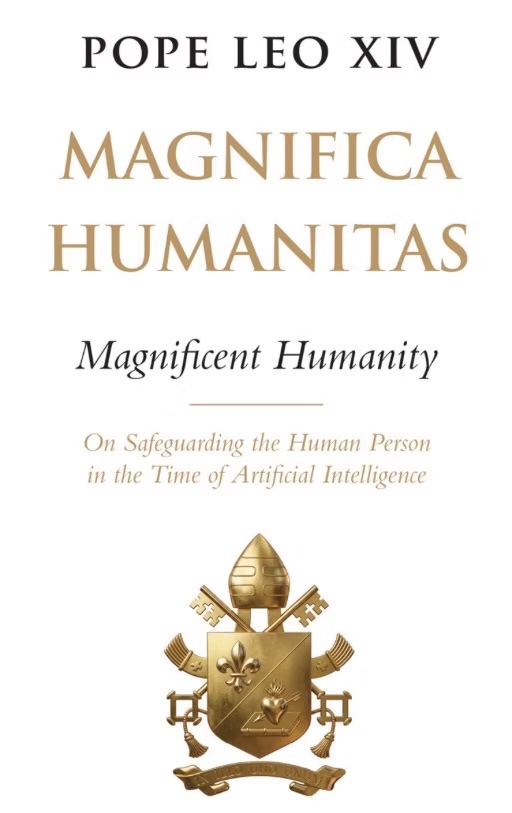
I have finally finished Magnifica Humanitas, resisting the urge to get an AI generated summary. Motivated by the Pope’s call to action, and the comments of Anthropic’s Chris Olah during the release, I wanted to risk being immodest and share some thoughts.
Over the past 18 months I’ve delivered a dozen talks on AI ethics to several thousand people including engineers, lawyers, business leaders, and developers, and in each Q&A somebody would say something along the lines of, “I’m worried about where it’s all going, and I’m not sure who is steering the ship.”
Olah commented during the press conference that AI needs, “informed voices who will tell the labs where we are failing.. moral voices that incentives cannot bend.” His comments reinforce a commercial reality: AI development is going to follow demand, and the systems we build will reflect our collective priorities.
The uses we choose for AI reveal something about what we value and what we want to give away. Tellingly, its most popular applications are not curing disease, advancing science, or helping us govern more wisely. We ask for help to write love letters to our spouses, navigate difficult conversations, and provide companionship. We’re building orbital data centres to outsource more and more of the work of thinking, writing, and relating.
I started in decision support systems fifteen years ago, when most people had a visceral reaction to the callous modelling of human factors. We quietly ranked independent quantitative variables across some output like employee productivity to inform corporate policy and incentivization programs. People used to fight against being quantified, and now it’s accepted universally. People happily announce their own input parameters.
MH rejects that – “Building for the common good means accepting the limits and weakness of humanity without considering them an error to be corrected[…] true fulfilment is not achieved through eliminating weakness but through harmonious growth [where] freedom and responsibility are intertwined [and] where progress is measured by the dignity of each person and the good of all peoples.” High functioning teams aren’t those with the optimal allocation of experience points. It’s fellowship and trust that bring the best out of everybody and lead to real fulfilment.
This shift in how we view ourselves, from persons to optimizable systems, has real consequences. Pope Francis wrote in Fratelli Tutti that “the sum of individual interests is not capable of generating a better world for the whole human family.” If we save time writing letters to those we love and outsourcing more of the difficult work of communication and relationship-building we’ve traded real utility for superficial productivity.
For those who haven’t read Magnifica Humanitas, or reflected on how their own use of AI is guiding both their lives and the development of the technology, I’d encourage you to do so. It’s the users that are steering the ship, and if we use hyper-advanced technology to support our disordered propensity to put immediate desires ahead of higher goods, it only builds a more isolated future. The dignity inscribed in each of us can be seen in our capacity to reflect critically, choose and love freely, and form authentic relationships.
Magnifica Humanitas closes with a beautiful observation: “Even when machines excel in efficiency, a human face that asks to be gazed upon remains the center of our history.” Let Claude reword your rousing memo, but don’t ask it to tell your children you love them.
 Jeremy Adamson